Dynamic Physical Adversarial LED Patterns via Reinforcement Learning
Closed-loop control of a wearable LED array to evade person detectors.
Abstract
Physical adversarial attacks today are static. This one is not.
Physical adversarial attacks expose limitations of computer vision systems, but most existing methods rely on static patches or textures. We study closed-loop physical adversarial control, where an agent adapts a programmable emissive actuator using environmental observations and black-box detector feedback during training. We implement this setting using a wearable RGB LED array and Physically Regularized Soft Actor-Critic (PR-SAC) with latent action parameterization. Across YOLOv8, Faster R-CNN and RetinaNet, dynamic PR-SAC achieves attack success rates of 89.1 %, 84.7 % and 86.8 %, outperforming optimized static LED patterns by 38.3–42.1 percentage points. Evaluation in unseen locations shows reduced but substantial attack effectiveness. We further analyze input-processing defenses and persistent training instability, including Q-drift and entropy collapse. Our results highlight the importance of evaluating adaptive physical attacks through direct evasion metrics, environmental generalization and training stability.
Automated person detection is now routine in surveillance, access control and scene monitoring, which raises the question from both sides: how reliable are these systems against perturbations that adapt, and what recourse does someone who has not consented to being tracked actually have? Printed patches, adversarial T-shirts and camouflage textures are all optimized once and then fixed. Light, distance and viewing angle keep changing. The pattern doesn't.
Our question
Can an emissive pattern that adapts to the scene, using only black-box detector feedback, beat a fixed one?
Testbed
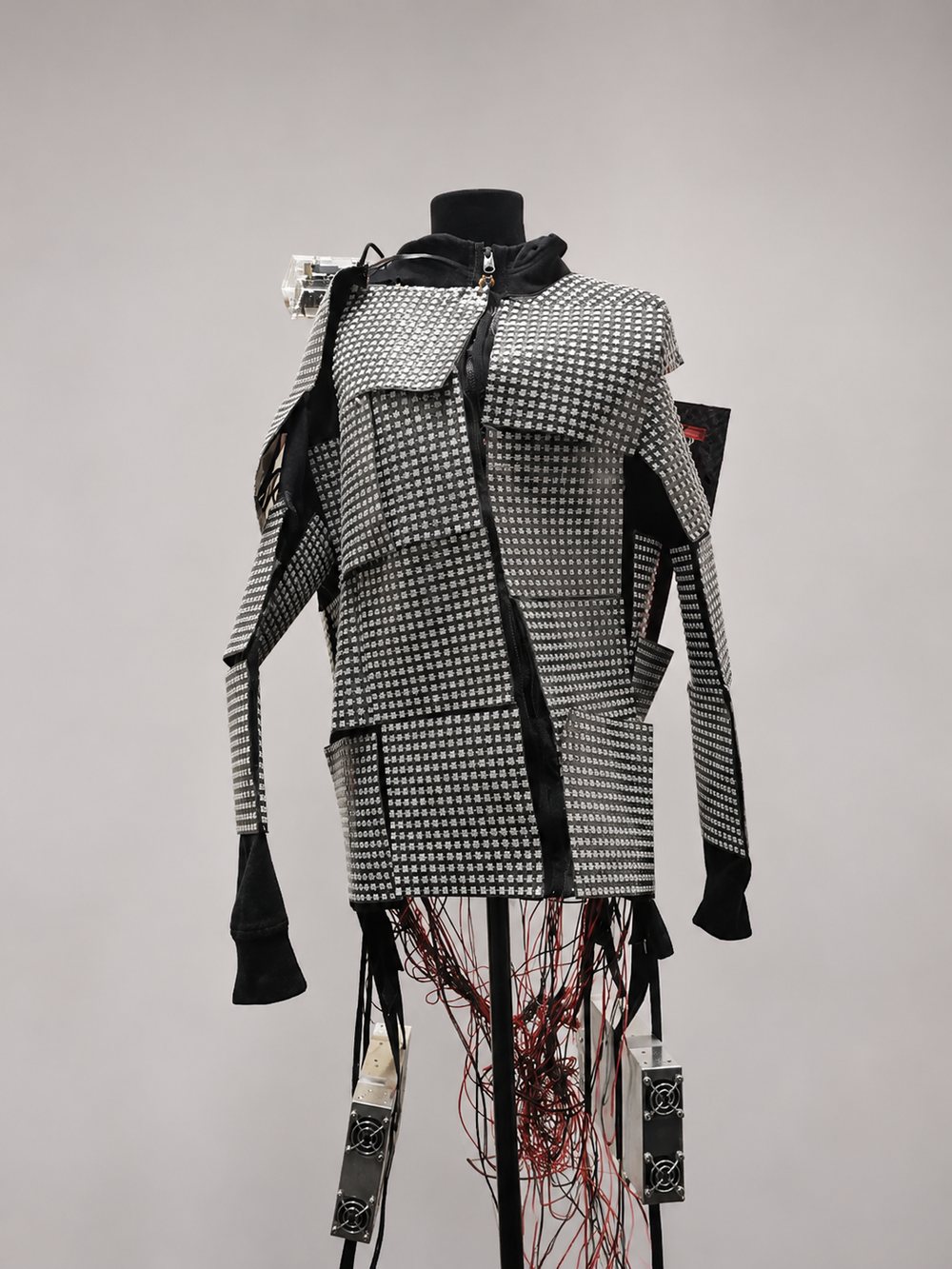
A wearable array of 9,984 RGB LEDs
- Two onboard cameras, front and back, are what the policy observes — sensors, not evaluation cameras.
- A separate external camera feeds the target detector, so attack performance is measured independently of what the policy sees.
Formulation
The attack as a closed-loop RL problem
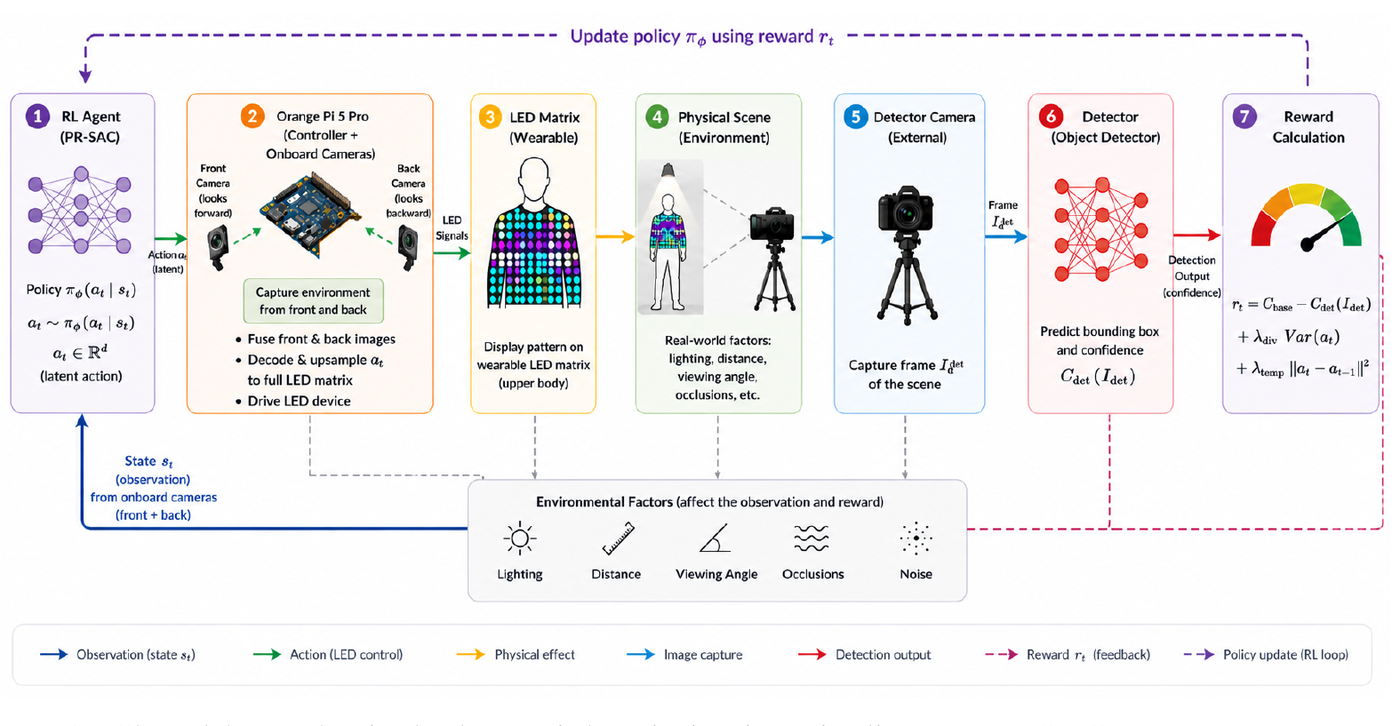
+ λdiv · Var(at)
+ λtemp · ‖at − at−1‖2
The first term drives detector confidence down; the auxiliary terms reward diversity and temporal variation. The whole reward is a stochastic physical composition — rendering, then detection, then measurement noise — which is what makes it non-stationary.
Black-box throughout. No gradients, no detector weights, no access to the evaluation camera. Training sees detector confidence and the two onboard cameras; at test time the policy generates patterns from onboard observations alone, with no detector feedback at all.
Section 3.3Method
PR-SAC: three fixes on top of Soft Actor-Critic
Off-policy RL destabilizes in a physical loop for three reasons: every detector score carries sensor noise, the scene drifts so the Bellman operator becomes time-dependent, and replayed transitions stop matching the current policy. The result is Q-drift, entropy collapse and degradation after the peak. Each fix targets one cause.
Regularize the actor
Penalize jumps between neighboring LEDs and between consecutive frames, biasing learning toward physically consistent trajectories.
Down-weight noisy transitions
The critic loss is weighted by the estimated reward variance, so unreliable physical feedback counts for less.
Recency-weighted replay
Stale samples from an older scene are discounted, reducing the mismatch between the replay buffer and the current environment.
These improve stability in practice. PR-SAC comes with no formal convergence guarantee — the Bellman operator is genuinely time-dependent in this setting. Sections 4.2 and 4.4
Action space
Latent actions tame 29,952 dimensions
Direct LED-level control reaches several thousand dimensions and destabilizes the critic. We act in a small latent space, then decode and upsample deterministically onto the full array.
Degradation after the peak falls along with it: 0.19 → 0.18 → 0.13. The upsampling factor itself trades detail for stability — low factors keep high-frequency detail but are unstable, high ones over-smooth, and an intermediate factor is best. Table 1 and Figure 4b, mean over 15 runs
Main result
Adapting beats any fixed pattern
The decisive comparison is PR-SAC (dynamic) against PR-SAC (frozen) — the same trained policy, pinned to a single pattern. The gain comes from adapting, not from the pattern itself.
| Method | YOLOv8 | Faster R-CNN | RetinaNet |
|---|---|---|---|
| Clean | 0.4 ± 0.2 | 1.4 ± 0.9 | 0.6 ± 0.5 |
| Random LED | 8.7 ± 3.8 | 10.6 ± 4.1 | 7.9 ± 3.6 |
| CMA-ES (static) | 43.5 ± 5.4 | 45.1 ± 5.1 | 47.8 ± 5.3 |
| Vanilla SAC | 61.9 ± 6.0 | 55.8 ± 6.8 | 54.6 ± 6.3 |
| PR-SAC (frozen) | 50.8 ± 5.9 | 42.6 ± 5.5 | 46.8 ± 5.4 |
| PR-SAC (random snapshot) | 22.5 ± 4.9 | 20.8 ± 4.5 | 15.7 ± 4.3 |
| PR-SAC (dynamic) | 89.1 ± 4.3 | 84.7 ± 5.0 | 86.8 ± 3.8 |
| PR-SAC (unseen locations) | 77.3 ± 5.4 | 69.8 ± 5.6 | 74.5 ± 5.2 |
Generalization
New locations: weaker, but still strong
Trained policies evaluated without fine-tuning in locations excluded from training — new backgrounds, geometry and illumination. Attack success falls from 89.1 / 84.7 / 86.8 % to 77.3 / 69.8 / 74.5 %, still above every static baseline measured in familiar conditions (≤ 50.8 %).
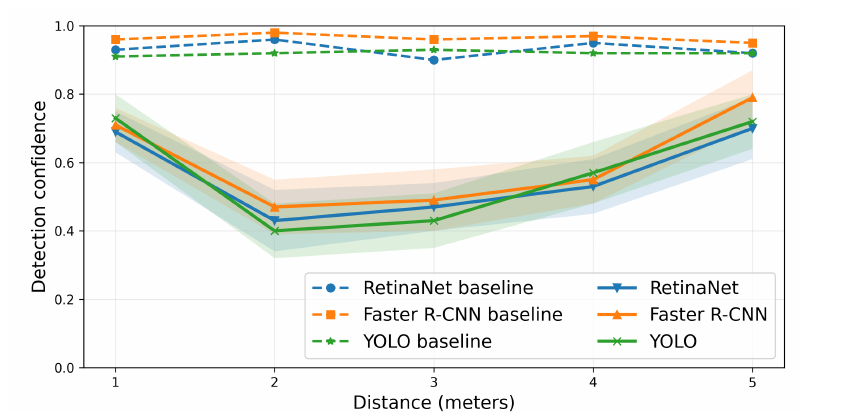
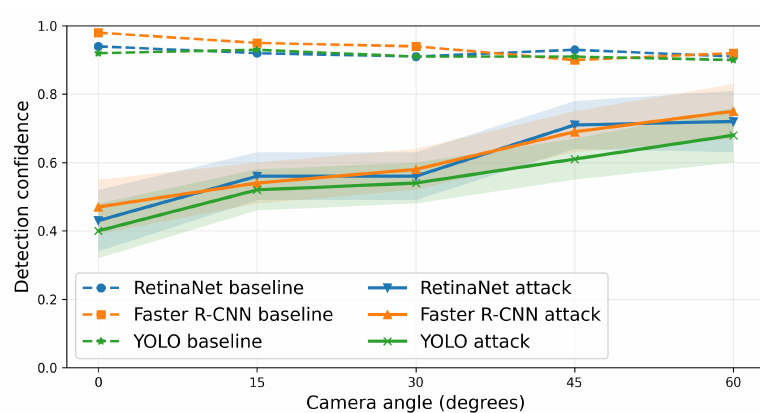
Partial environmental generalization — not robustness under arbitrary outdoor or sensor conditions. Section 5.1
Transferability
Patterns partially transfer across detectors
| Train ↓ · Test → | YOLO | Faster R-CNN | RetinaNet |
|---|---|---|---|
| YOLO | 0.40 | 0.48 | 0.51 |
| Faster R-CNN | 0.52 | 0.47 | 0.56 |
| RetinaNet | 0.54 | 0.55 | 0.43 |
Diagonal 0.40 / 0.47 / 0.43; off-diagonal 0.48–0.56, against 0.92–0.96 with no attack.
Defenses
Dedicated defenses help; none removes the attack
Generic transformations leave substantial residual evasion. Purpose-built physical-attack filters do markedly better, but RAPID — the strongest tested — still leaves 17.6–29.8 % attack success.
| Defense | YOLOv8 | Faster R-CNN | RetinaNet |
|---|---|---|---|
| No defense | 89.1 % conf. 0.40 | 84.7 % conf. 0.47 | 86.8 % conf. 0.43 |
| Gaussian blur | 61.2 % conf. 0.54 | 56.8 % conf. 0.56 | 69.4 % conf. 0.51 |
| JPEG compression | 63.6 % conf. 0.53 | 58.9 % conf. 0.59 | 71.0 % conf. 0.56 |
| Morphological | 39.8 % conf. 0.69 | 30.9 % conf. 0.73 | 46.5 % conf. 0.66 |
| UDFilter | 35.7 % conf. 0.70 | 27.8 % conf. 0.74 | 41.2 % conf. 0.68 |
| RAPID | 24.6 % conf. 0.74 | 17.6 % conf. 0.78 | 29.8 % conf. 0.72 |
Stability
Entropy collapse is delayed, not removed
The entropy coefficient α falls from about 1.0 to 0.04 over a run, and action variance peaks near episode 700 before collapsing. PR-SAC pushes that collapse later but does not eliminate it, and it coincides with the degradation phase below. Checkpoints are therefore selected by minimum mean confidence on a held-out validation sequence — never the final one.
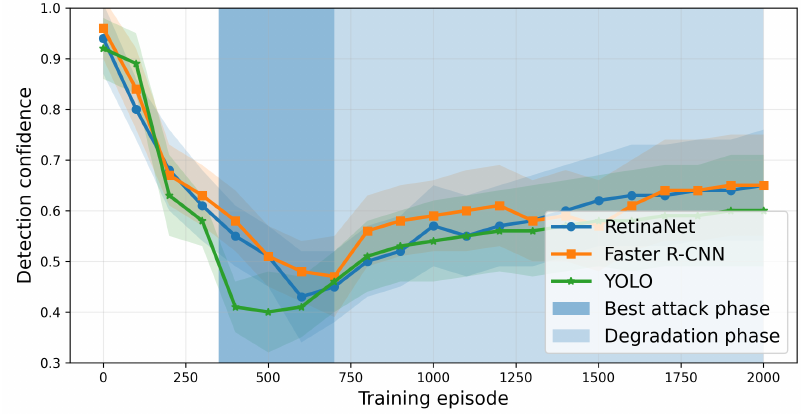
Protocol. ASR is the percentage of frames with no person detection matching the ground-truth box at IoU ≥ 0.5 and confidence ≥ 0.6. Every number on this page is a mean over 15 independent seeds × 300 evaluation frames, with 95 % Student-t intervals; each run is 2,000 episodes of roughly 10–12 s, about 5–6 hours. An operator varies pose, viewpoint, distance and illumination on a schedule shared by every compared method. Section 4.5
Limitations & impact
What this does not show
Three person detectors and one wearable LED platform. Unseen-location results do not establish robustness under uncontrolled conditions, and other target classes, other actuators, adversarially trained detectors and certified defenses remain untested. Training is unstable. Adaptive physical attacks could be misused against surveillance or safety-critical perception; our aim is the opposite — better robustness evaluation under realistic physical conditions.
Responsible release
To mitigate misuse risks, we do not release real-time deployment tools or optimized policies for specific targets.
Citation
BibTeX
@inproceedings{zyryanov2026dynamic,
  title     = {Dynamic Physical Adversarial {LED} Patterns via Reinforcement Learning},
  author    = {Konstantin Zyryanov and Nikita Lotts},
  booktitle = {Advances in Neural Information Processing Systems 40 (NeurIPS 2026)},
  year      = {2026}
}